
← Glossary
Glossary
Game aggregator vs white label: what's the difference?
In iGaming, an aggregator supplies games; a white label supplies the whole operation under the provider's licence. Compare cost, control and launch speed.
Updated
Definition
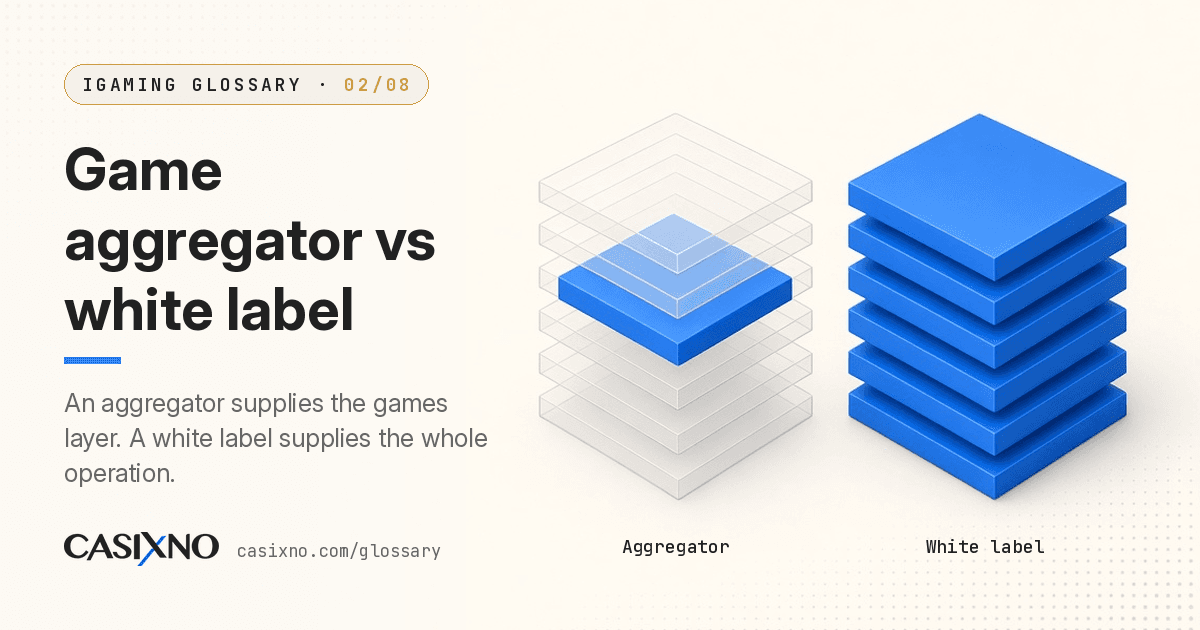
- Game aggregator: the games layer. One integration and one contract bring games from many studios to your site.
- White label: the whole iGaming operation (platform, games, payments, compliance) run under the provider's licence, with your brand and domain on top. The provider is the licensed operator in law.
In short: an aggregator gives you games; a white label gives you a business to run on someone else's licence.
Example
- Person A has a platform and a licence but no games → signs an aggregator and fills the lobby with one integration.
- Person B has an audience but no platform, licence or tech team → takes a white label and focuses on brand and players.
Formula
- Aggregator: Content cost = GGR from its games × (studio share + aggregator margin); platform, payments and licence paid separately.
- White label: Provider's take = revenue share of NGR (typically 10–30%), or a monthly fee plus a smaller share.
- GGR = player bets − player wins (total amount wagered minus winnings paid to players). NGR = GGR − bonuses and promotions − gaming taxes and levies − other fees (exact deductions depend on the contract or the regulator).
Comparison
| Game aggregator | White label | Turnkey | |
|---|---|---|---|
| What you get | Games from many studios | Platform + games + payments + compliance | Platform + integrations; you operate |
| Licence | Not included | Provider's licence | Your own licence |
| Launch speed | Depends on your platform | Launch in weeks | Slower: about 3–9 months |
| Control & data | Your platform; catalogue set by aggregator | Limited; customer relationship sits with provider | High; own data |
| Typical pricing | Share of GGR on its games | 10–30% of NGR, or fee + smaller share | Licence fee + revenue share |
Impact on the owner
- Aggregator if you already run a platform and only need content.
- White label if speed and low setup effort matter more than control. Note: several regulators now restrict white-label setups and require brands to hold their own licence.
- Either way, check what is deducted before your share: content fees and promotions both move NGR.
How it works in practice
With an aggregator, the operator runs its own platform, payments and licence and plugs the aggregator in as the games layer; it carries the compliance work and pays content fees from GGR. With a white label, the provider runs platform, payments, games and compliance under its licence; the brand runs marketing and players, and the provider takes a revenue share of NGR or a fee. In both, read the contract for what is deducted before the brand's share.
FAQ
- They solve different jobs: an aggregator supplies games; a white label supplies the whole operation.
- Usually yes, often through an aggregator.
- The provider; the brand runs under its licence and rules.
- White label: provider's licence. Turnkey: your own licence, you buy the platform.