
Glossary
What is GGR (gross gaming revenue)?
GGR is wagers minus winnings paid to players in a period. How to calculate it, how it differs from deposits and NGR, and why supplier fees are quoted on it.
Updated
Definition
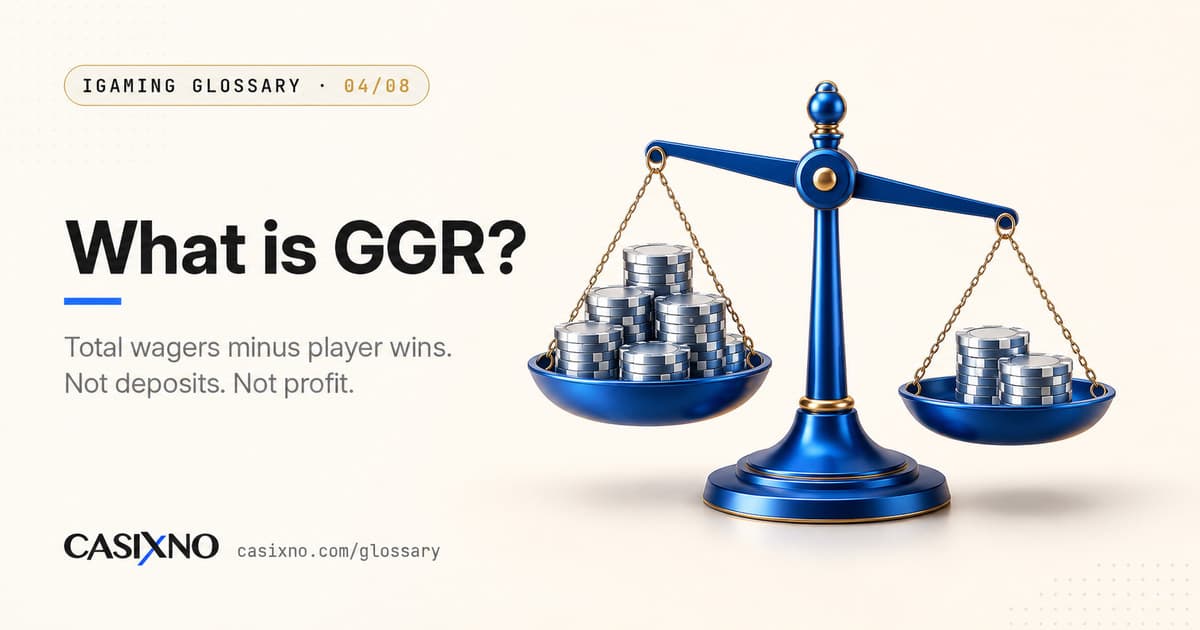
Gross gaming revenue, GGR, is the money a gaming site keeps from play in a period: everything players wagered minus everything they won. It is the top line of an iGaming business, before bonuses, taxes, content fees and any other cost. (source: iGaming Times glossary)
GGR is not deposits and not turnover. Deposits are money moved into player wallets; turnover (handle) is the total wagered; GGR is the slice of turnover that did not go back to players. (source: iGaming Times glossary)
Example
In one month players wager 2,000,000 USDT across the lobby and win 1,920,000 USDT. GGR is 80,000 USDT, a 4.0% hold, which matches a blended RTP of about 96%. The same site may have taken only 150,000 USDT in deposits that month, because most wagers are winnings re-wagered. (Illustrative numbers.)
Formula
-
GGR = total bets − total wins (on settled rounds in the period). (source: iGaming Times glossary)
-
Hold (%) = GGR ÷ total bets × 100. Over large volumes, hold approaches 100 − blended RTP.
-
Worked example (illustrative): bets 2,000,000 − wins 1,920,000 = GGR 80,000; hold 4.0%.
-
Per-game GGR = that game's bets − its wins; the lobby GGR is the sum, which is why one jackpot can make a provider negative for a month.
Comparison
-
GGR vs NGR: NGR = GGR − bonuses and promotional costs − gaming taxes and levies − other agreed fees; NGR is the base of most revenue-share contracts. (source: iGaming Times glossary)
-
GGR vs deposits: deposits measure cash in; GGR measures the house result of play. A site can have high deposits and low GGR (lucky players) or the reverse.
-
GGR vs turnover: turnover counts every wager including re-wagered winnings; GGR is typically 2–6% of turnover for a slots-heavy lobby, depending on RTP mix. (source: iGaming Times glossary)
-
GGR vs profit: GGR is before every cost; profit is what remains after content, payments, marketing, staff and tax.
Impact on the owner
-
Almost every supplier fee is a percentage of GGR: studios and aggregators take their share of the GGR their games produce, and regulated markets tax GGR. The GGR line therefore drives both your revenue and your largest costs. (source: iGaming Times glossary)
-
GGR swings with variance. A month with a large jackpot can show low or negative GGR for one provider while turnover was normal; judge the lobby on rolling periods, not single days.
-
Bonuses do not reduce GGR; they reduce NGR. A site that gives generous bonuses can post strong GGR and weak NGR in the same month.
-
In crypto sites GGR is usually reported in a reference currency; conversion timing changes the figure, so the reporting rule should be fixed in the contract.
How it works in practice
The platform records every bet and every win per round and settles them per game session. Back-office reports sum bets and wins by game, provider, player segment and day, and show GGR, hold and actual RTP per cut. Cancelled or void rounds are excluded; progressive jackpot contributions and payouts are reported separately by most providers. Monthly supplier invoices and revenue-share statements are reconciled against the same GGR report, so one agreed definition of a settled round and of the reporting currency is what keeps the statements matching. (source: iGaming Times glossary)
FAQ
- It is gross revenue from gaming only; sports, fees or other income are reported separately.
- Yes, for a game, a provider or a short period, when wins exceed bets; over a large lobby and a full month it is normally positive.
- GGR measures the value their games created; deposits are a cash-flow figure that does not depend on the games.
- For a slots-heavy lobby, a few percent of turnover; it follows the blended RTP of what players actually play.
- Usually yes, bets funded by bonus balance count as bets; the bonus cost is deducted later, in NGR. (source: iGaming Times glossary)